
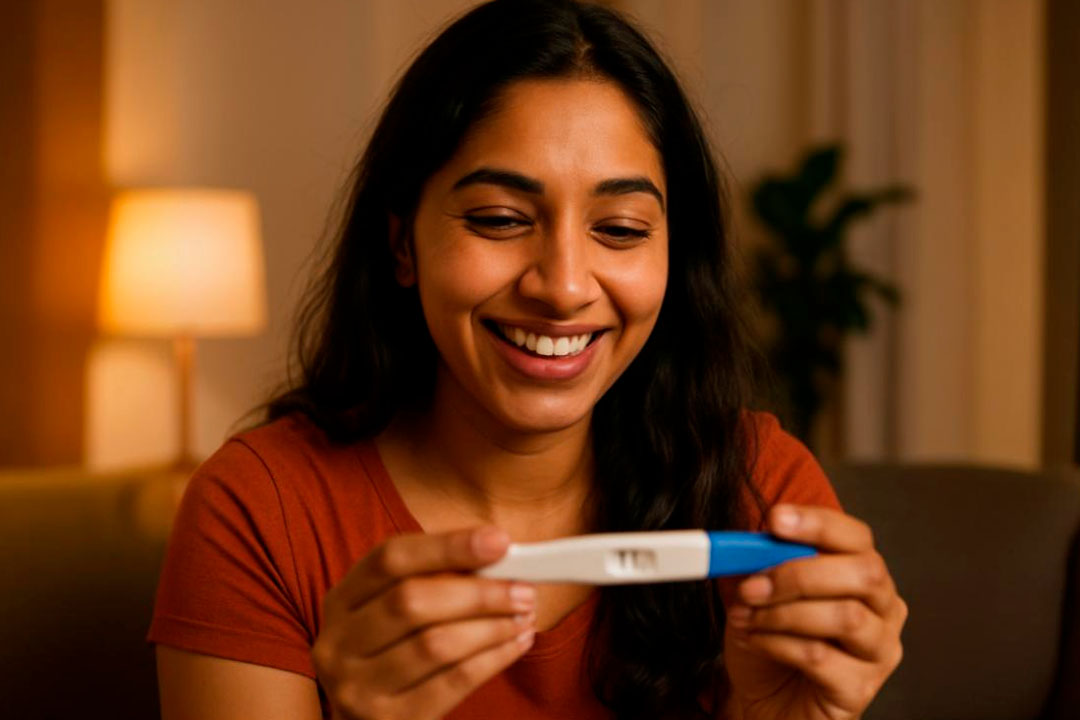
Most people are told that “you can get pregnant mid-cycle,” but the reality is a little more precise. In each menstrual cycle there’s a short span of days when sex is most likely to lead to pregnancy.
This span is called the fertile window. It exists because sperm can stay alive in the reproductive tract for a few days, while an egg stays viable for only a short time after ovulation.
When these two timing curves overlap, conception becomes possible. Understanding that overlap and how to spot it in your own cycle turns guesswork into a simple plan you can follow.
Fertile Window: Meaning and Basics
The fertile window is the 6-day span that ends on the day of ovulation (the 5 days before ovulation plus ovulation day).
That window exists because sperm can survive up to ~5 days, while the egg remains fertilisable for about 12–24 hours after ovulation. When live sperm are already present as the egg is released, chances of pregnancy are highest.
Researchers have shown that conception occurs almost exclusively during this 6-day window, with the odds rising as you move closer to ovulation. In a classic study, the chance was roughly 10% five days before ovulation and peaked around one-third on the day of ovulation.
Ovulation and The Fertile Window in the Menstrual Cycle
Ovulation is when an ovary releases a mature egg. It usually happens about 14 days before your next period starts, not always “on day 14” for everyone. So, if your cycle is regular, the fertile window shifts with your cycle length, but it still ends on your ovulation day. ACOG
- 21-day cycle (shorter): Ovulation may be around day 7; fertile window ~days 2–7.
- 28-day cycle (typical): Ovulation may be around day 14; fertile window ~days 9–14.
- 35-day cycle (longer): Ovulation may be around day 21; fertile window ~days 16–21.
Because many people don’t ovulate on the exact same calendar day every cycle, it’s smart to use more than one sign (calendar, cervical mucus, LH surge, temperature) to find your own pattern.
What are Fertile Window Symptoms?
The most reliable everyday sign is a change in cervical mucus to a clear, stretchy “raw egg white” texture just before ovulation. That slippery mucus helps sperm travel and is a strong indicator that you’re in your high-fertility days.
Some people also notice a mild, one-sided lower-abdominal twinge called mittelschmerz near ovulation, along with a small temperature rise after ovulation.
Common fertile-window clues
- Cervical mucus: Becomes wetter, clear, and stretchy as ovulation approaches.
- Mittelschmerz (ovulation cramps): Brief, localized ache on one side of the lower abdomen for some people.
- Basal body temperature (BBT): Rises slightly after ovulation due to progesterone (helpful for confirming that ovulation already happened).
- Libido shifts: Some notice a natural increase mid-cycle.
Cervical-mucus tracking can be used alone or alongside other methods to sharpen timing. Office on Women's Health
How to Calculate the Fertile Window
Track your cycles for a few months, then combine a calendar estimate with body signs and, if you like, an ovulation predictor kit (OPK).
1) Calendar estimate (good starting point):Note the first day of each period for at least 6 months. A practical rule used in public-health materials: subtract 18 from your shortest cycle and 11 from your longest cycle to mark the earliest and latest fertile days. The days between those marks cover your likely window. (Use this only as a guide, pair it with the signs below.)
2) Cervical mucus (real-time signal):When mucus becomes abundant, clear, and stretchy, you’re likely in your high-fertility phase already. Keep an eye on it daily.
3) LH testing (prediction):Urine OPKs detect a surge in luteinizing hormone (LH) that typically precedes ovulation by ~24–36 hours. A positive test means ovulation is approaching; time sex the day of the surge and the next day.
4) Basal body temperature (confirmation):BBT rises a bit after ovulation, so it confirms that your fertile window has just ended. It’s useful for learning your pattern over time, not for same-day prediction. (Pair it with other methods.)
Special Notes for Irregular Cycles
If your cycles vary a lot, you can still use body signs and LH testing to find fertile days, but the calendar method alone won’t be dependable.
If you go months without a period, or if cycles are consistently shorter than 21 days or longer than 35 days, consider a check-in to look for underlying reasons (such as thyroid conditions, PCOS, or other factors).
Ovulation vs. Fertile Window: What’s the Difference?
Ovulation is a single event whereas the fertile window is the multi-day period when sex can lead to pregnancy. Because sperm can live for days and the egg lasts only hours, sex before ovulation is more forgiving than sex after ovulation.
In practical terms, the most effective strategy is to have sex in the two to three days before ovulation and on ovulation day.
Fertile window after period depends on your cycle length. Count forward from the first day of your period to estimate when ovulation might happen (about 14 days before your next period), then look for fertile signs in the 5 days leading up to that estimate.
If your cycles are short, your fertile days can begin soon after bleeding stops; if they’re long, they’ll start later. Use mucus changes and/or an OPK to refine the estimate.
Can You Only Get Pregnant During the Fertile Window?
Yes, conception essentially happens only during the six days that end on ovulation day. Large studies tracking hormone changes confirmed that pregnancies were linked to sex in this specific window.
Outside those days, the chance is extremely low because there’s no viable egg, or the sperm cannot persist long enough. (The catch is that estimating the window can be off by a day or two, so relying on rough calendars alone can be risky if avoiding pregnancy.)
How Likely is Pregnancy Outside the Fertile Window?
Very unlikely. The egg’s lifespan is short, and sperm cannot fertilize an egg that isn’t present. Reports of pregnancy “outside the window” usually reflect earlier-than-expected ovulation or mis-dated cycles.
That’s why pairing a calendar with mucus observations or LH tests gives a more accurate picture.
Frequently Asked Questions
It’s the 5 days before ovulation plus ovulation day, 6 days total. That’s when sperm survival and egg viability can overlap. The chance of pregnancy rises as you get closer to ovulation, peaking on the day itself.
If your cervical mucus looks like raw egg white or your LH test is positive, you’re likely at peak fertility. Use a calendar estimate to know when to start testing or watching for mucus, then time sex during those “wet” days and on LH-positive days.
Mittelschmerz pain is directly tied to ovulation, which is technically only a 24-36 hour period of time when LH levels peak and an egg is released from the ovary for 24 hours. Ovulation pain is likely to last up to a few hours or even a day or two
Mild mid-cycle cramps can be normal for some people. They’re often brief and one-sided. Seek care for severe or persistent pain, or if it’s paired with heavy bleeding or fever.
It varies by cycle length. For a 28-day cycle, many people’s fertile days begin around day 9 and run through day 14. Shorter cycles shift the window earlier; longer cycles shift it later. Pair calendars with mucus or LH tests for accuracy.
It’s highly unlikely. Most conceptions come from sex during the six-day span ending on ovulation day. If you conceived when you thought you were outside the window, ovulation likely occurred earlier than you estimated.
Not necessarily. Many experts suggest sex every other day during the fertile window, which balances timing with sperm quality and reduces stress. The key is to cover the two days before ovulation and ovulation day.
They can help you record patterns, but they’re only as good as the data you give them. Apps that incorporate mucus tracking or LH testing tend to be more accurate than calendar-only predictions.
Combine methods. If mucus is confusing due to infections, medications, or postpartum changes, lean on LH testing and cycle tracking for a few months to learn your rhythm.
Conclusion
Knowing your fertile window turns a vague idea of “mid-cycle” into a clear, personal plan. The science is straightforward: sperm can wait around for a few days; the egg can’t. That simple difference creates a six-day opportunity that you can recognize and use.
Start with a calendar estimate, strengthen it with cervical-mucus checks, and, if you like, confirm with an LH test.
If cycles are irregular, lean more on signs than on dates. With a bit of practice, your fertile window will be easy to spot—and you can use it to try for pregnancy with far less stress and far more confidence.

About Us
AKsigen IVF is a premier center for advanced fertility treatments, with renowned fertility experts on our team. Specializing in IVF, ICSI, egg freezing, and other cutting-edge reproductive technologies, AKsigen IVF is committed to helping couples achieve their dream of parenthood. With personalized care and a patient-first approach, AKsigen IVF provides comprehensive fertility solutions under one roof.


 +91 86556 78747
 info@aksigenivf.com


